About me

I am a Robotics Researcher. I am currently working as a Senior Researcher at the Secure Systems Research Center in Technology Innovation Institute, Abu Dhabi, UAE. I obtained my Ph.D. from the University of Michigan, Ann Arbor, MI, USA with specialization in Aerospace Engineering. My research interests are in Robotics and Artificial Intelligence with a focus on developing intelligent multi-robot systems that coordinate together, collaborate with and assist humans to accomplish wide range of complex tasks autonomously, safely, securely and resiliently.

Feel free to navigate through this webpage to know more!

Research Interests

  1. Multi-Agent Systems: Coordination, Collaboration, Planning, Control and Resiliency

  2. Human-Robot Collaboration and Interaction

  3. Aritifical Intelligence for Robotics

Recent News

  1. Attended Abu Dhabi AI-Robotics Conference (AIRoC) 2025 in Abu Dhabi, UAE.

  2. Our paper got accepted in ICRA 2025, Atlanta, USA.

  3. Attended and presented our research at GenZero Workshop 2024 in Abu Dhabi, UAE.

  4. Presented our research at IROS 2024 in Abu Dhabi, UAE.

  5. Attended International Conference on Automation Science and Engineering (CASE) 2024 in Bari, Italy.

  6. Our paper got accepted in IROS 2024, Abu Dhabi, UAE.

  7. Our paper got accepted in ICRA 2024, Yokohama, Japan.

  8. Our research paper "Aerial Swarm Defense using Interception and Herding Strategies" got accepted in TRO

  9. Presented our research on human-robot interaction in CCTA2023, Bridgetown, Barbados.

  10. Our research paper got accepted in CCTA2023, Bridgetown, Barbados.

  11. Our research paper "Robust Leader-Follower Formation Control for Human-Robot Scenarios" got accepted in ACC 2022.

  12. Our research paper "Aerial Swarm Defense by StringNet Herding: Theory and Experiments" got accepted in Frontiers in Robotics and AI.

  13. Our Research paper "Multi-Agent Planning and Control for Swarm Herding in 2D Obstacle Environments under Bounded Inputs" got accepted in TRO.
Education

Education

  1. Doctorate

    University of Michigan, Ann Arbor

    Sep 2017 — Aug 2022

    Ph.D. in Aerospace Engineering GPA: 3.9/4 Advisor: Dimitra Panagou

  2. Graduate

    University of Michigan, Ann Arbor

    Sep 2017 — Aug 2022

    M.S.E in Aerospace Engineering GPA: 3.9/4

  3. Undergraduate

    Indian Insitute of Technology Kanpur

    2012— 2017

    B.Tech-M.Tech dual degree program in Aerospace Engineering CPI: 10/10 in M.Tech and 9.3/10 in B.Tech Advisors: Abhishek and Mangal Kothari

    * Received Academic Excellence Award for 3 academic sessions 2012-13, 2014-15, 2015-16 for distinctive academic performance.

Experience

Work Experience

  1. Senior Researcher

    Nov 2023 — Present

    Secure Systems Research Center,
    Technology Innovation Institute, Abu Dhabi, UAE.

  2. Postdoctoral Research Associate

    Apr 2023 — Nov 2023

    Department of Mechanical and Industrial Engineering,
    Northeastern University, Boston, MA, USA.

  3. Planning Engineer

    Jun 2022 — Feb 2023

    ThorDrive Inc., Cincinnati, OH, USA

Teaching Experience

  1. Graduate Student Instructor

    Sep 2021 — Dec 2021

    Control of Aerospace Vehicles (AEROSP 470), University of Michigan

  2. Graduate Student Instructor

    Sep 2019 — Dec 2019

    Navigation and Guidance of Aerospace Vehicles (AEROSP 584), University of Michigan

  3. Teaching Assistant

    Jul 2016 — Nov 2016

    Experiments in Aerospace Engineering (AE 451A), IIT Kanpur

Professional Service

  1. Reviewer for Journals

    1. Transactions on Robotics (TRO)

    2. Autonomous Robots

    3. Automatica

    4. IEEE Robotics and Automation Letters (RA-L)

    5. IEEE Control Systems Letters (L-CSS)

    6. Journal of Field Robotics

    7. Nonlinear Dynamics

    8. Open Journal of Control Systems (OJ-CSYS)

    9. Transaction on Mechatronics (T-Mech)

    10. Journal of Aerospace Information Systems (JAIS)

    11. Transaction on Aerospace and Electronic Systems (TAES)

  2. Reviewer for Conferences

    1. International Conference on Robotics and Automation (ICRA)

    2. International Conference on Intelligent Robots and Systems (IROS)

    3. Conference on Decision and Control (CDC)

    4. American Control Conference (ACC)

    5. European Control Conference (ECC)

    6. Symposium on Multi-Robot and Multi-Agent Systems

    7. International Conference on Hybrid Systems: Computation and Control (HSCC)

    8. SciTech

    9. Symposium on Multi-Robot and Multi-Agent Systems

Research

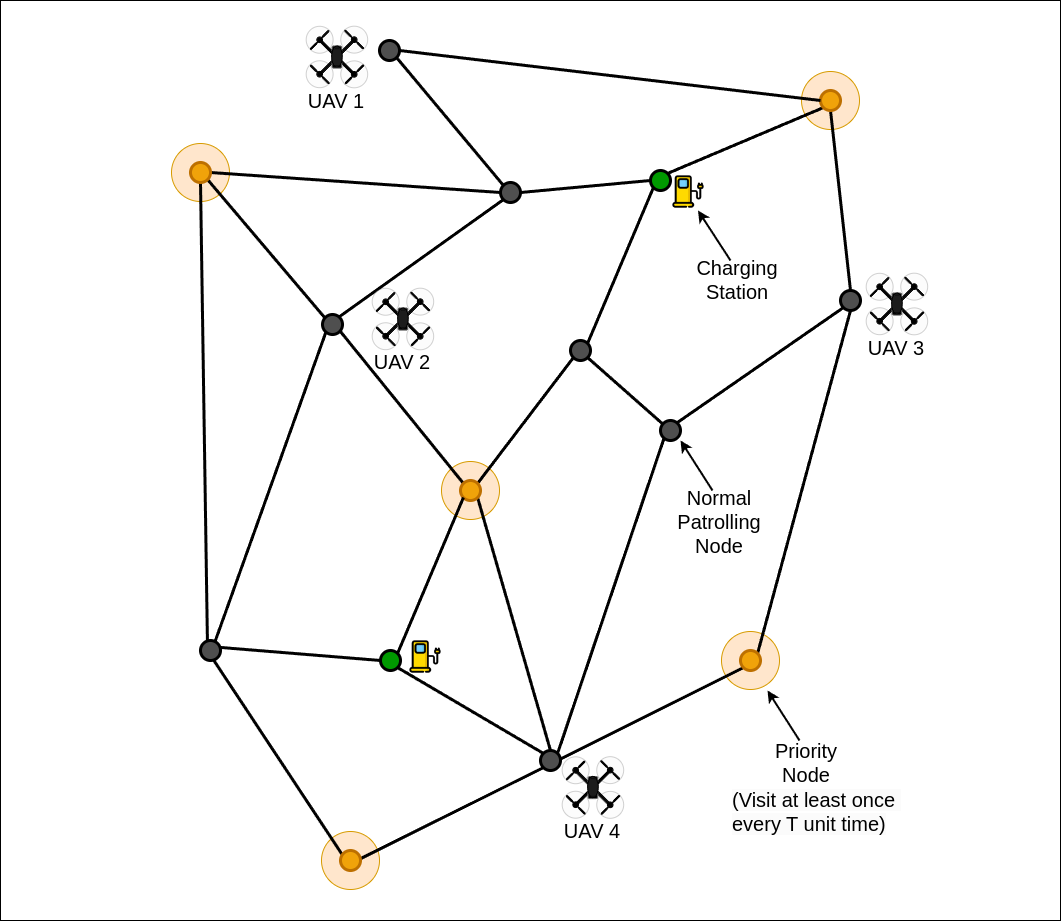
  • Battery Constrained Multi-Robot Priority Surveillance

    HRI using LLMs
    In this project, we are developing distributed motion planning algorithms for multi-robot systems that are patrolling a large area of importance such that they satisfy the following constraints:
    • The robots need to visit some priority nodes at least once every fixed amount of time (i.e., priority patrolling);
    • All other nodes in the area are visited by one or more robot;
    • The robots need to ensure their battery is always above the required threshold for safe operation (i.e., battery constraint).
    The goal is to find a persistent joint policy for all the the robots in distributed manner to ensure that the total time to cover all the nodes at least once is minimized.
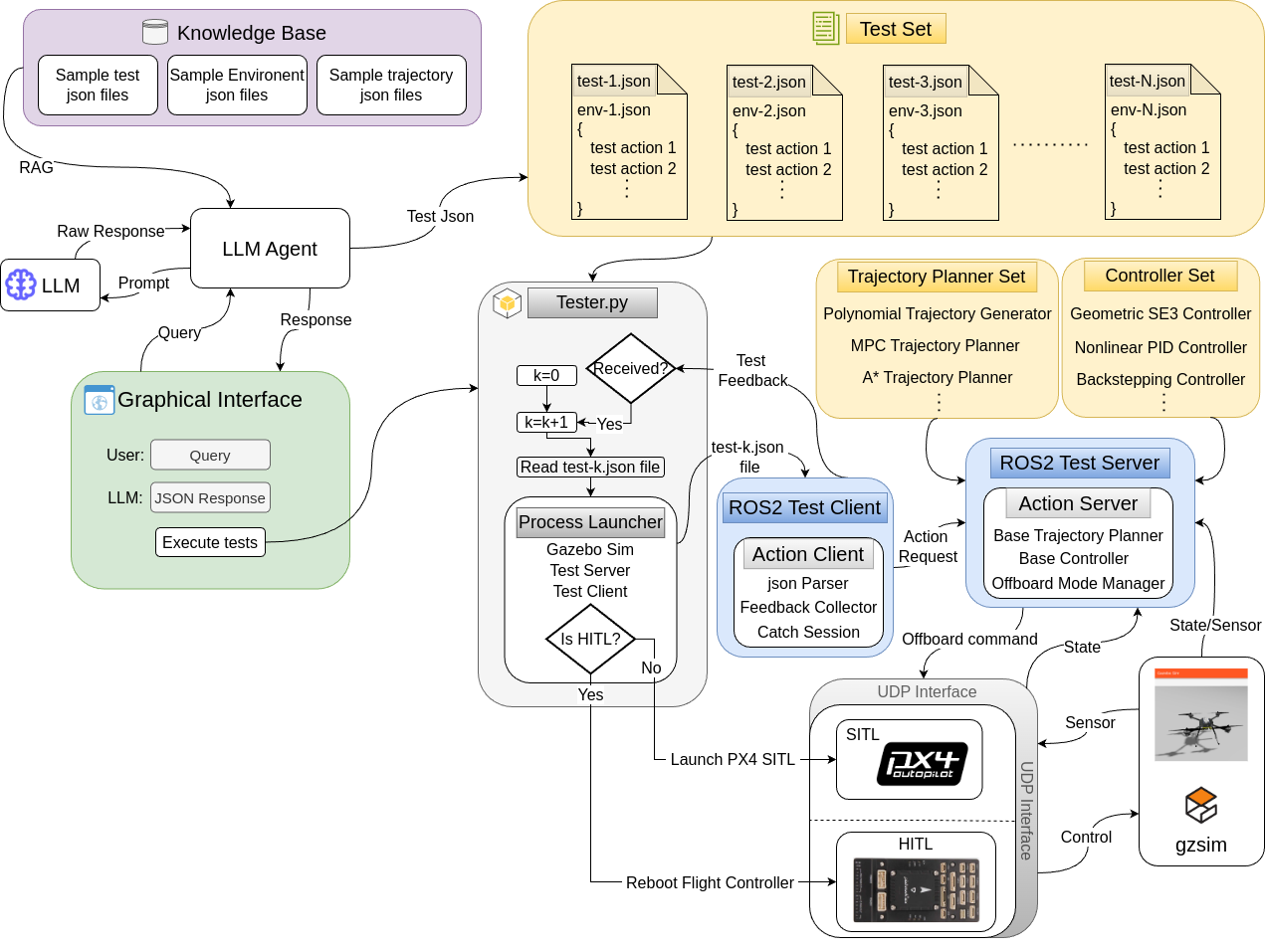
  • LLM Powered Fully Automated UAV SITL and HITL Testing

    LLM powered UAV SITL testing
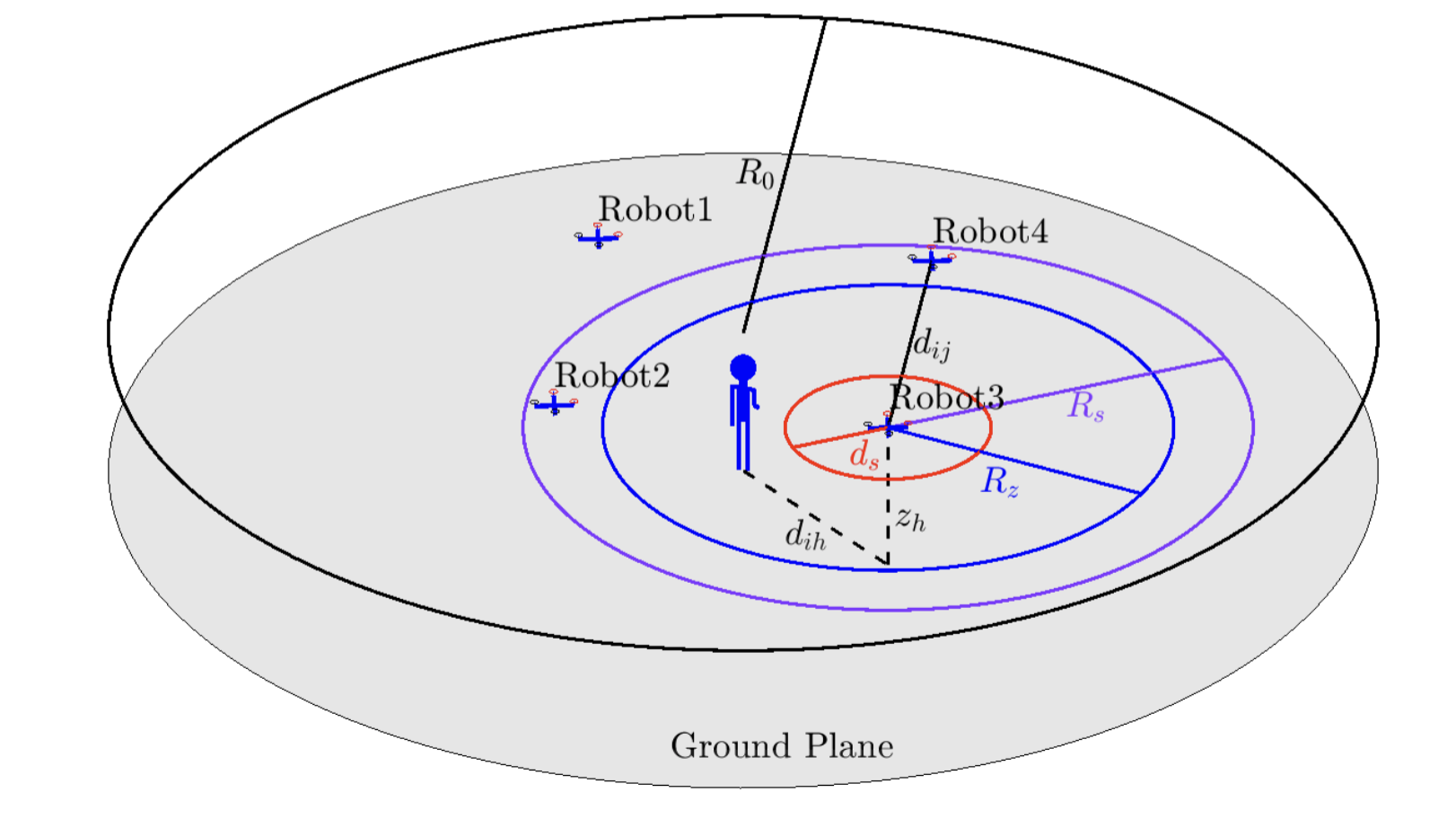
    In this project, we are developing a Large Language Model (LLM) powered fully automated tesing framework for testing PX4 software for UAVs in Software-in-the-loop (SITL) setting. This framework provides an chat-bot like user interface, where an user can provide a brief description of the tests they want to perform on an UAV using PX4 software stack. The framework then automatically generates test cases, all the configuration json files for running these test cases using LLM and then executes these states by running the ROS2 test client-server architecture.
  • Winding-Constrained Motion Planning for Tethered Robot

    Aerial Robots Inferring Human
Intent from Gaze Following
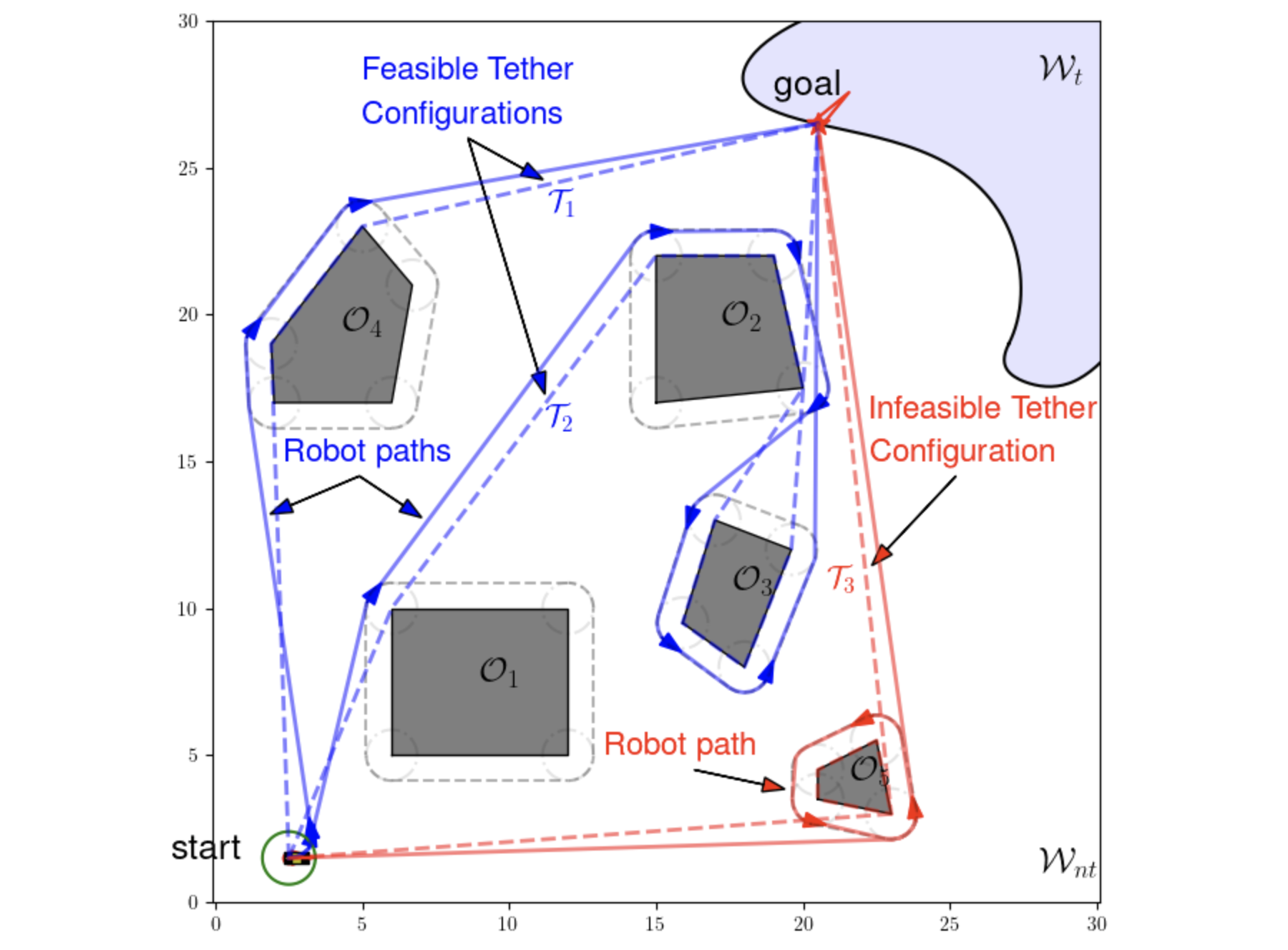
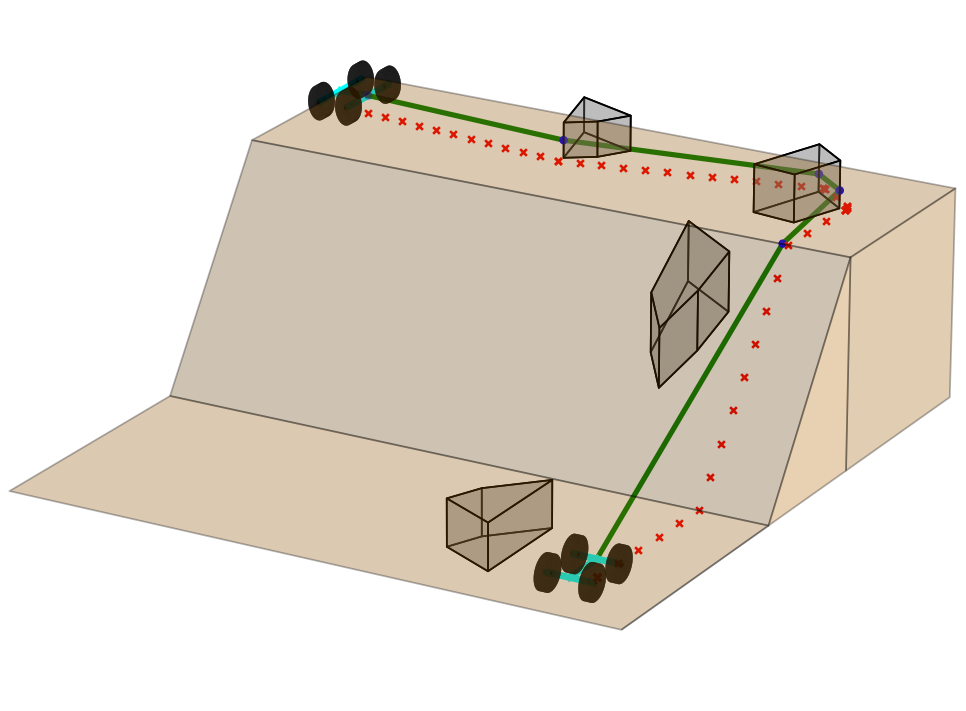
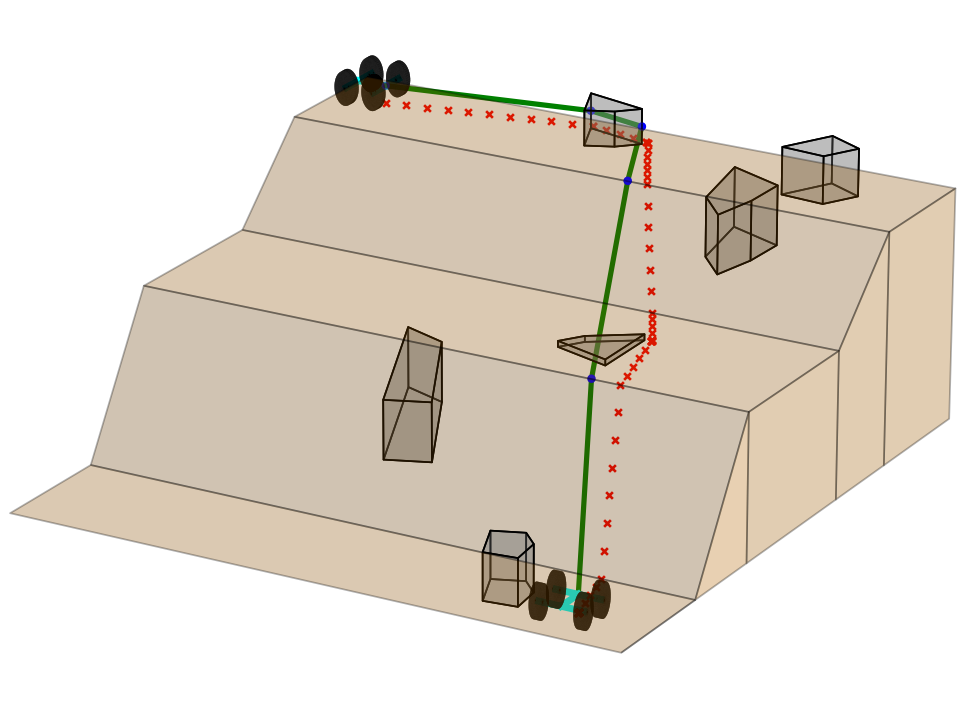
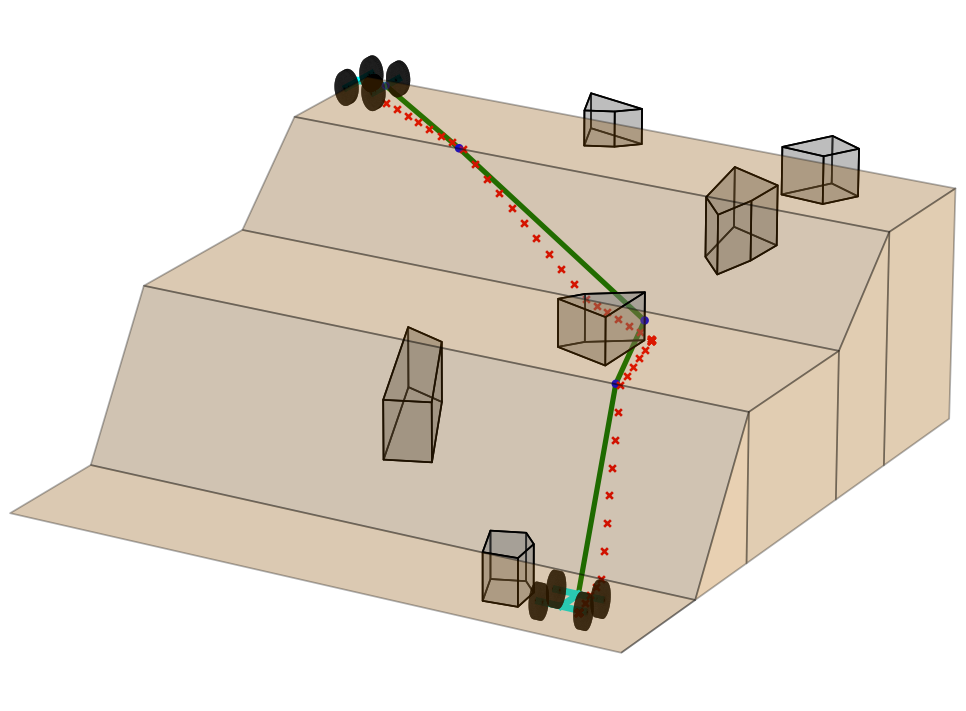
    In this project, we developed a winding constrained path search algorithm, that uses tangent based Hybrid A*, to find robot path that satisfies minimum requirement on winding around obstacles to ensure sufficient traction due to capstan effect that provides stability to the tethered robot navigating inclined terrains.
    References:
    1. Rahul Kumar, Vishnu S. Chipade, Sze Zheng Yong, "THAMP-3D: Tangent-based Hybrid A* Motion Planning for tethered robots in sloped 3D terrains," 2025 IEEE International Conference on Robotics and Automation (ICRA), Atlanta, USA, 2025.
    2. Rahul Kumar, Vishnu S. Chipade, Sze Zheng Yong, "Stability of a Team of Tethered Ground Robots on Extreme Terrains," 2024 IEEE/RSJ International Conference on Intelligent Robots and Systems (IROS), Abu Dhabi, UAE, 2024.
    3. Vishnu S. Chipade, Rahul Kumar, Sze Zheng Yong, "WiTHy A* : Winding-Constrained Motion Planning for Tethered Robot using Hybrid A*," 2024 IEEE International Conference on Robotics and Automation (ICRA), Yokohama, Japan, May 2024.
  • Aerial Multi-Robot System Inferring Human Intent from Gaze Following

    Aerial Robots Inferring Human
Intent from Gaze Following
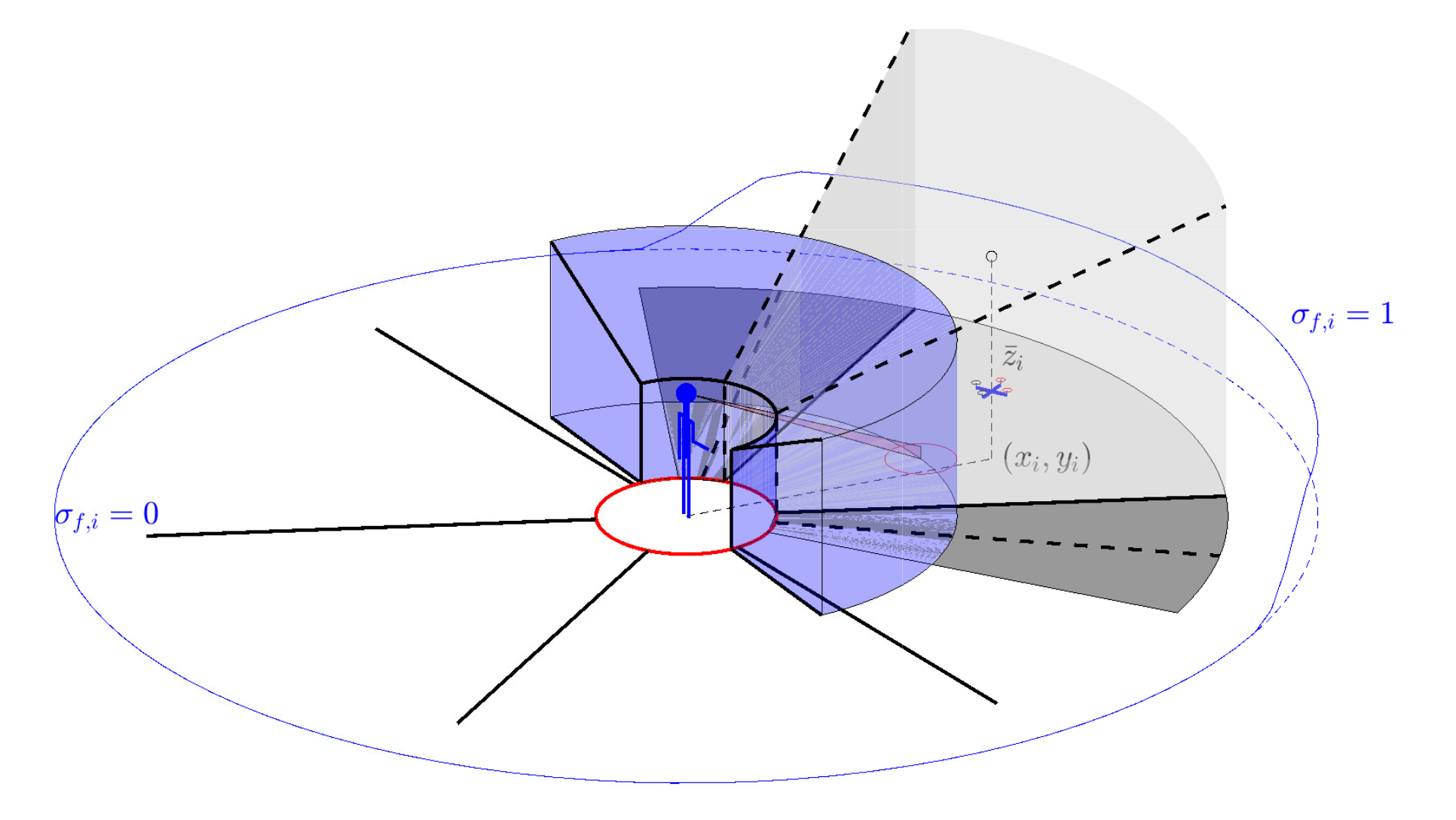
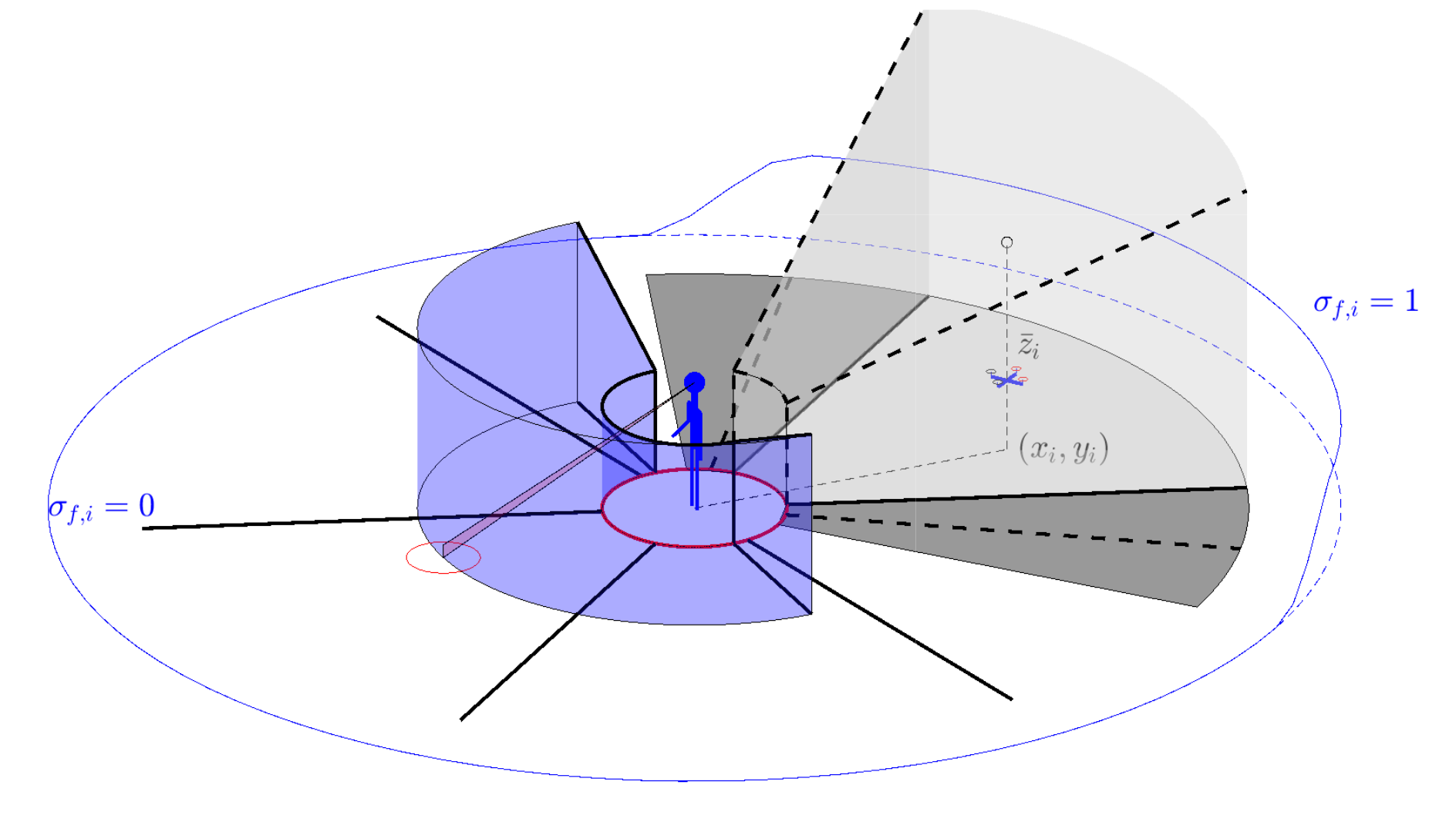
    In this project, we developed a coordination protocol for a team of aerial robots to infer the intention of the human in order to guide ground robots to assist the human, based on what the human is interested in, by visually following the human gaze and head orientation. We used XGaze algorithm for gaze estimation and developed a control strategy for the aerial robots to move them around the human so that the accuracy of gaze detection algorithm is maximized and hence the intention inference accuracy gets maximized.
    Reference:
    1. Vishnu S. Chipade, Alia Gilbert, Daniel Harari, Dimitra Panagou, "Collaborative Control of Aerial Robots for Inferring Human Intent from Gaze Following," 2023 IEEE Conference on Control Technology and Applications, Bridgetown, Barbados, Aug 2023.
    Simulated Experiments: Active Face Tracking by Drones
    Simulated Experiments: No Active Face Tracking by Drones
  • Robust Leader-Follower Formation Control in Human-Robot Scenarios

    Robust Formation Control in Human-Robot Scenarios
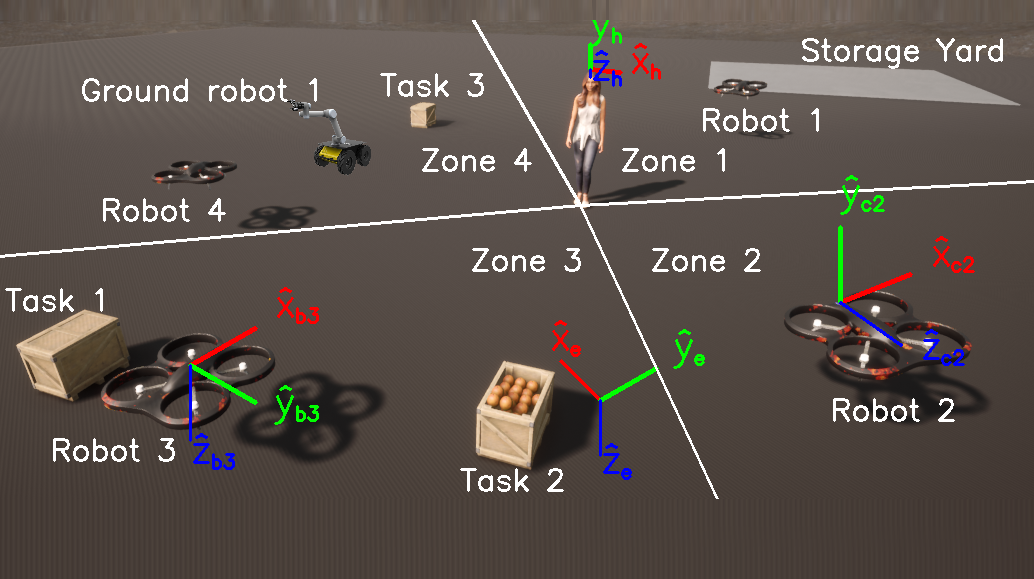
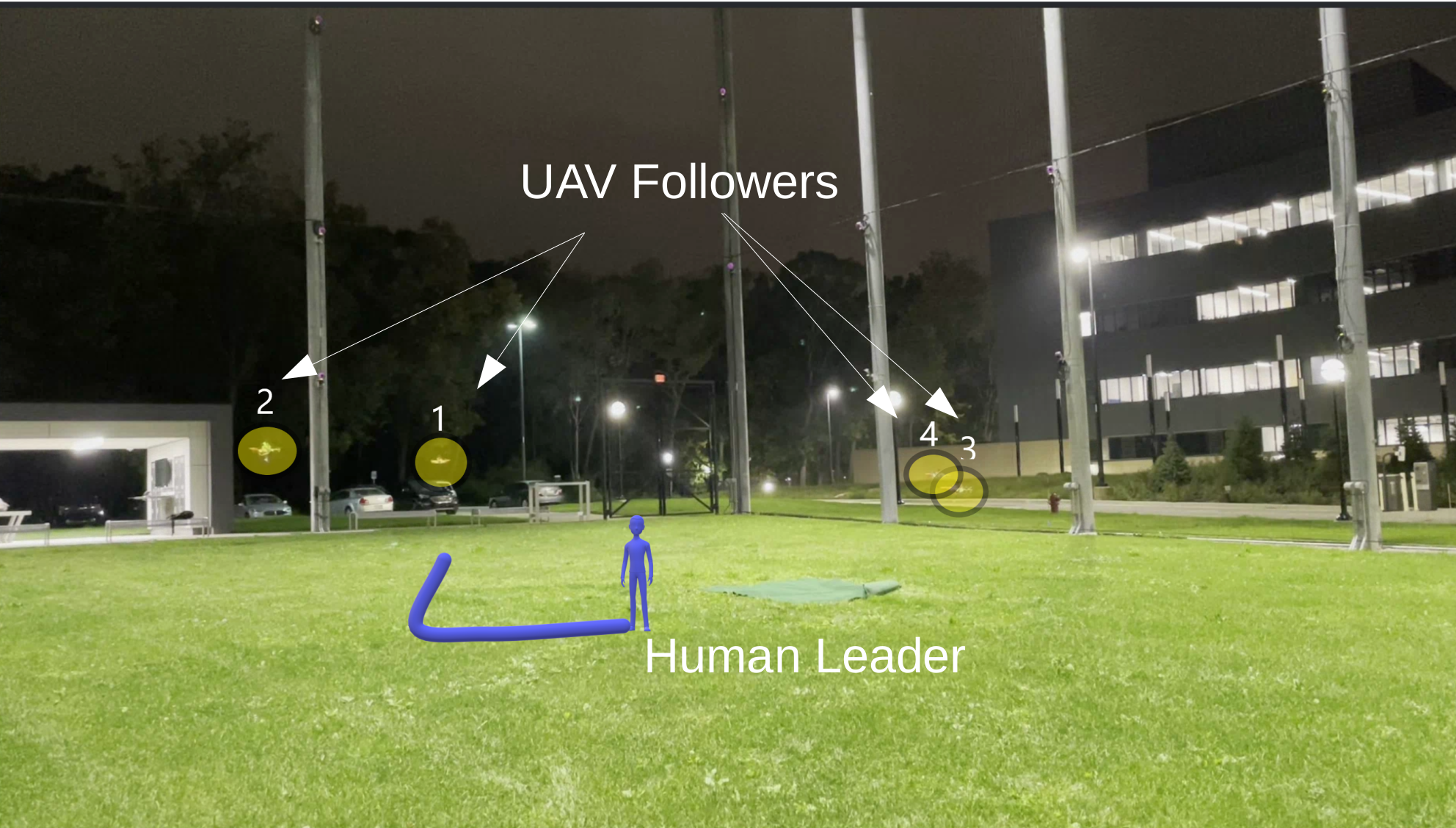
    In this project, we developed a robust leader-follower formation control algorithm for a team of robots (followers) to maintain a formation around a human (leader), despite having noisy position and velocity measurements of the other robots and the human leader. We utilized adaptive estimation algorithms for estimating robots' and human's states. We then developed formation control strategy based on these estimates and Lyapunov-like barrier functions for collision avoidance and connectivity maintenance, to achieve a desired formation of multiple robots around the human leader while maintaining connectivity and avoiding collisions in the presence of uncertainties in the human leader’s and follower robots’ own state information.
    Reference:
    1. Alia Gilbert, Vishnu S. Chipade, Dimitra Panagou, "Robust Leader-Follower Formation Control for Human-Robot Scenarios," 2022 American Control Conference, Atlanta, Georgia, June 2022.
  • Multi-modal Defense Strategy against Mutliple Adversarial Attackers

    Multi-modal defense against multiple attackers
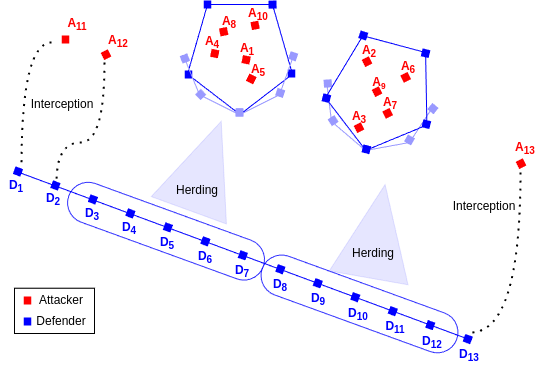
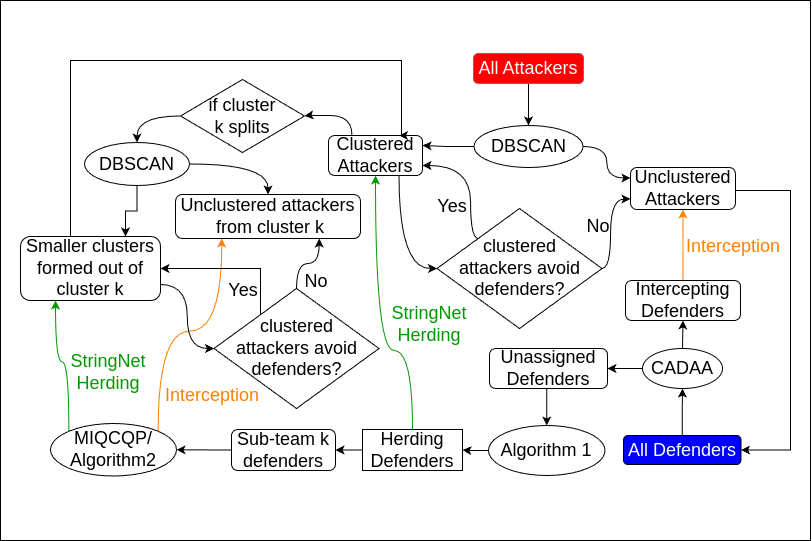
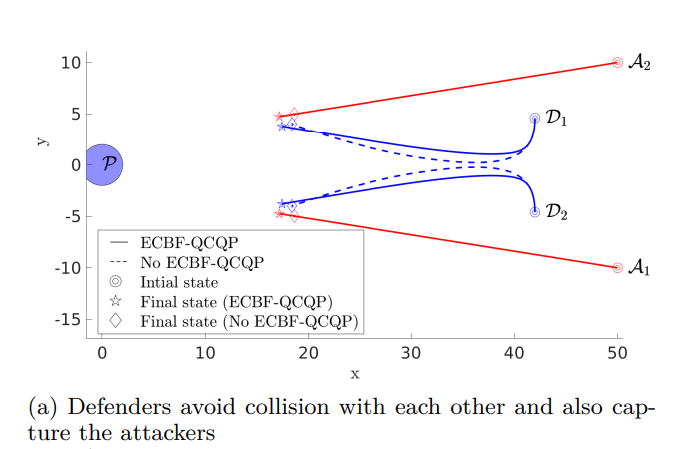
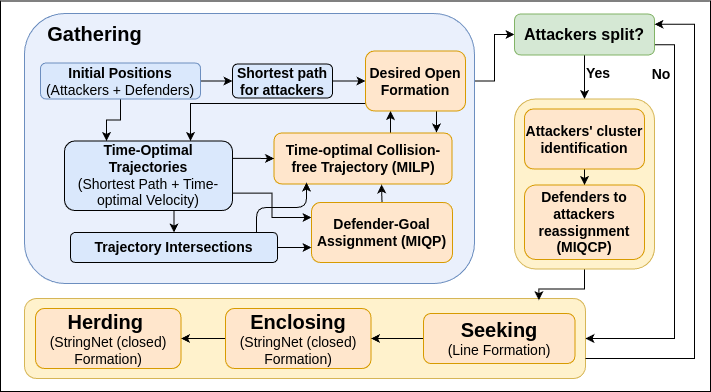
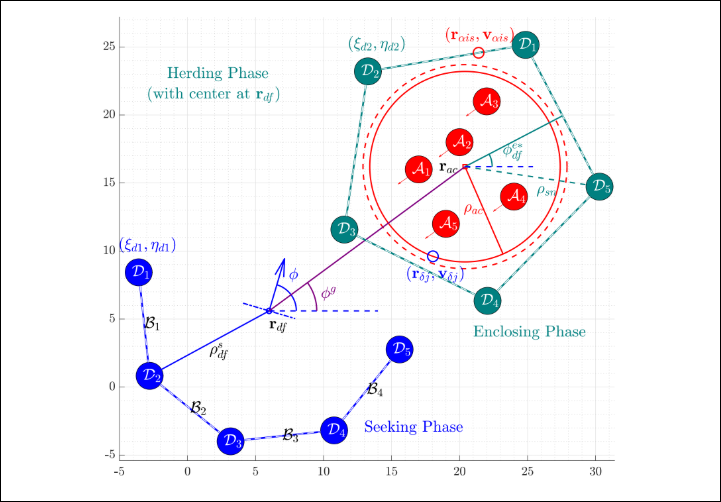
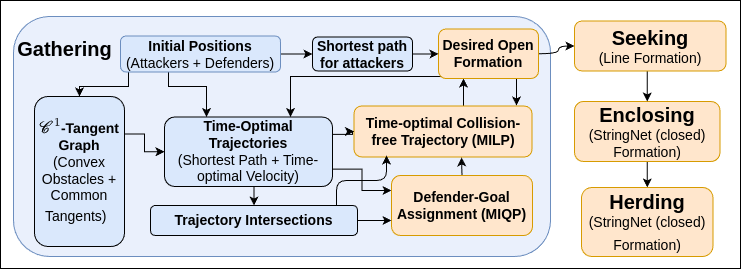
    In this project, we developed a multi-modal defense strategy for a team of defenders to defend a protected area against a team of adversarial attackers. This multi-modal strategy involves two modes of defense: 1) herding a swarm of attackers away from the protected area using StringNet herding strategy and 2) interception of adversarial attackers using the inter-defender collision-aware interception strategy. First, the attackers are classified as risk-averse or risk-taking in real-time using DBSCAN clustering algorithm based on their positions and velocities. Then, a combination of centralized and decentralized task assignment problems are solved using mixed integer programs to yield the multi-modal defense strategy for the defenders to handle complex behaviours exhibited by adversarial attackers.
    Reference:
    1. Vishnu S. Chipade, Dimitra Panagou, "Aerial Swarm Defense using Interception and Herding Strategies," IEEE Transactions on Robotics 39 (5), 3821-3837, Oct 2023
    MATLAB Simulations:
  • Inter-defender Collision-Aware Interception of Multiple Attackers

    Collision-Aware Interception
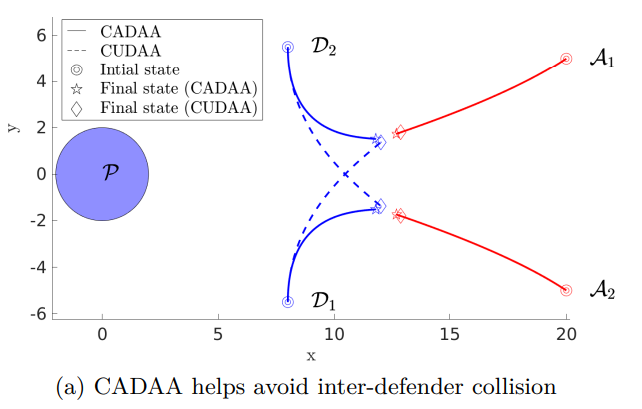
    In this project, we developed inter-defender collision-aware interception strategy (IDCAIS) for a team of defenders to intercept the advesarial attackers aiming to reach a protected area while ensuring defeders' own safety. We build on the time-optimal strategy for one defender to capture one attacker. We then provide collision-aware defender to attaker assignment (CADAA) by solving a mixed-integer quadratic program which finds assignment of the defenders to the attackers that minimizes the chances of the defenders colliding with other defenders on their time-optimal trajectories corresponding to the assigned attacker. The control actions of the defenders are further modified using control barrier function based correction term to avoid the collisions among the defenders when the collisions among the defenders are unavoidable just by virtue of optimal assignment.
    Reference:
    1. Vishnu S. Chipade, Dimitra Panagou, "IDCAIS: Inter-Defender Collision-Aware Interception Strategy against Multiple Attackers," (under review)
  • Herding Multiple Adversarial Multi-Robot Swarms

    Multi-Swarm Herding
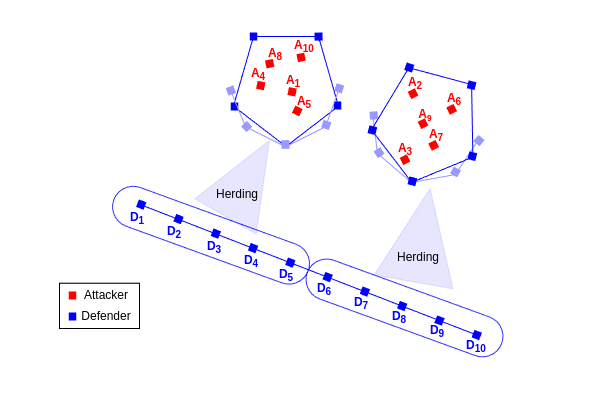
    In this project, we developed a herding strategy for a team of defenders to herd multiple swarms of attackers that do no stay together and may even dynamically split into smaller sub-swarms in the presence of the defenders. We used ‘Density-based Spatial Clustering of Application with Noise (DBSCAN)’ algorithm to identify the spatially distributed swarms of the attackers in real-time and the defenders are then assigned to each identified swarm of attackers by solving a mixed-integer quadratically constrained program (MIQCP).
    References:
    1. Vishnu S. Chipade, V. S. Aditya Marella, Dimitra Panagou, "Aerial Swarm Defense by StringNet Herding: Theory and Experiments," Frontiers in Robotics and AI, 8, p-81, 2021.
    2. Vishnu S. Chipade, Dimitra Panagou, "Multi-Swarm Herding: Protecting against Adversarial Swarms," 59th IEEE Conference on Decision on Control, Jeju Island, Republic of Korea, December 2020.
    MATLAB Simulations:
  • Herding Adversarial Multi-Robot Swarm

    StringNet Herding
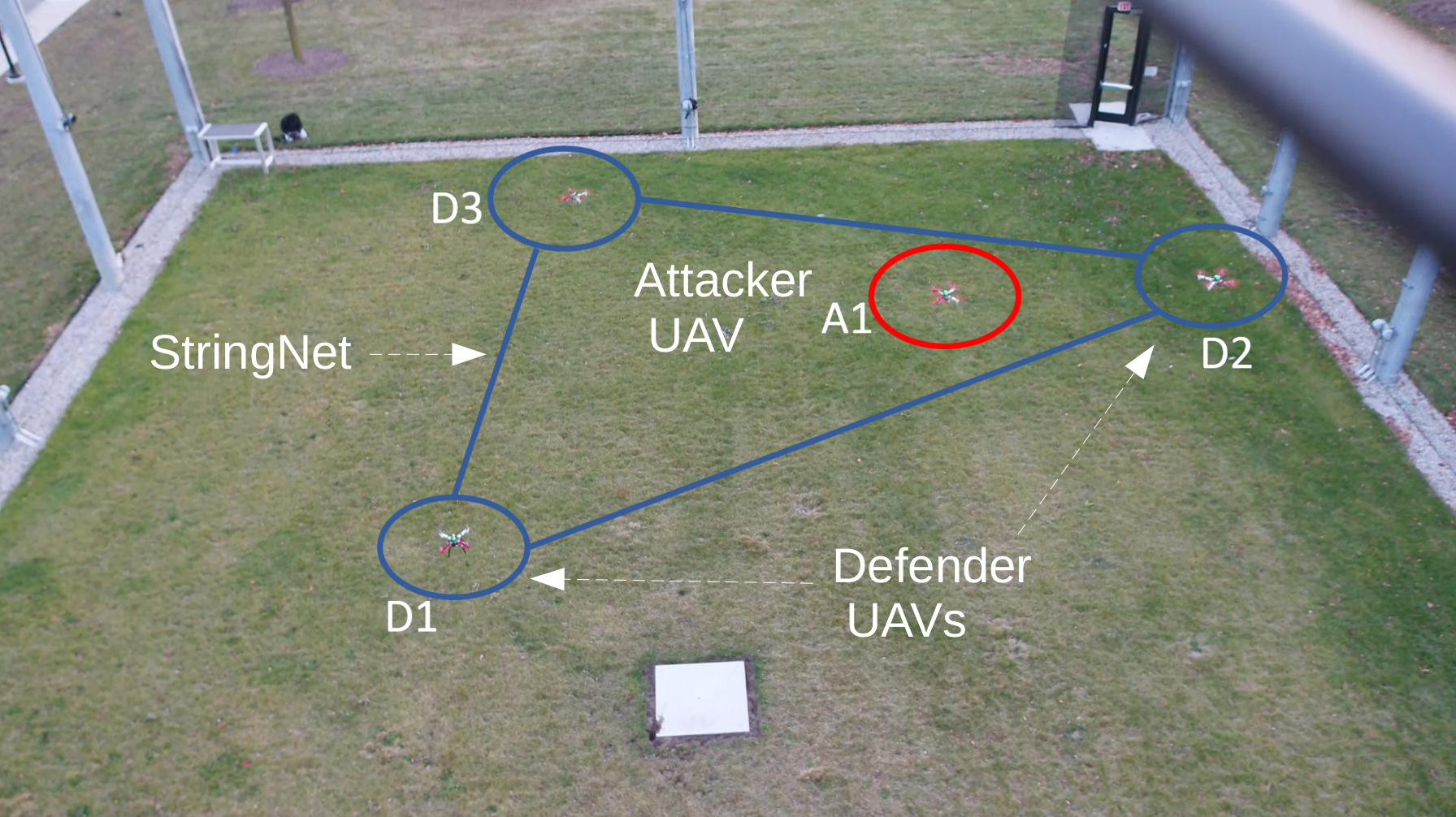
    In this project, we developed 'StringNet Herding' approach to herd an adversarial swarm by forming a closed formation of barriers (StringNet) formed by the defenders around the adversarial swarm in order to constraint the and control the attackers' motion. A combination of open-loop, near time-optimal controllers (that result in forming the defenders’ formation), and statefeedback controllers with finite-time convergence guarantees under bounded inputs (that guide the formation around attackers and towards the safe area) synthesize the herding strategy.
    References:
    1. Vishnu S. Chipade, Dimitra Panagou, " Multi-Agent Planning and Control for Swarm Herding in 2D Obstacle Environments under Bounded Inputs," IEEE Transactions on Robotics, 38(2), pp.-, May 2021.
    2. Vishnu S. Chipade, Dimitra Panagou, "Herding an Adversarial Swarm in an Obstacle Environment," 58th IEEE Conference on Decision on Control, Nice, France, December 2019.
    Experimental demonstration:
    Gazebo simulation:
    MATLAB Simulations:
  • Safe Autonomous Overtaking with Intent Estimation

    Safe Autonomous Overtaking
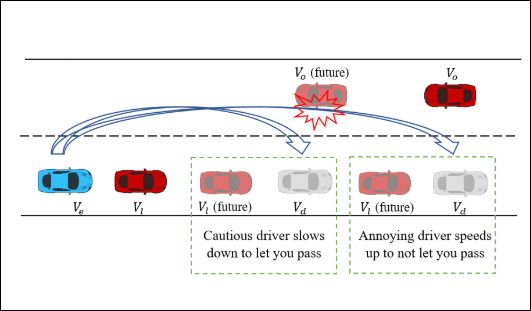
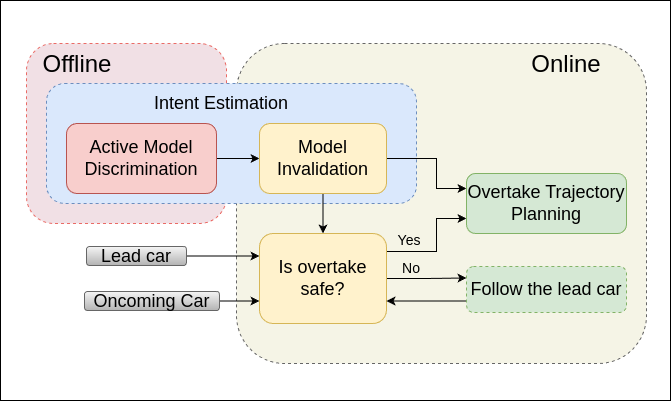
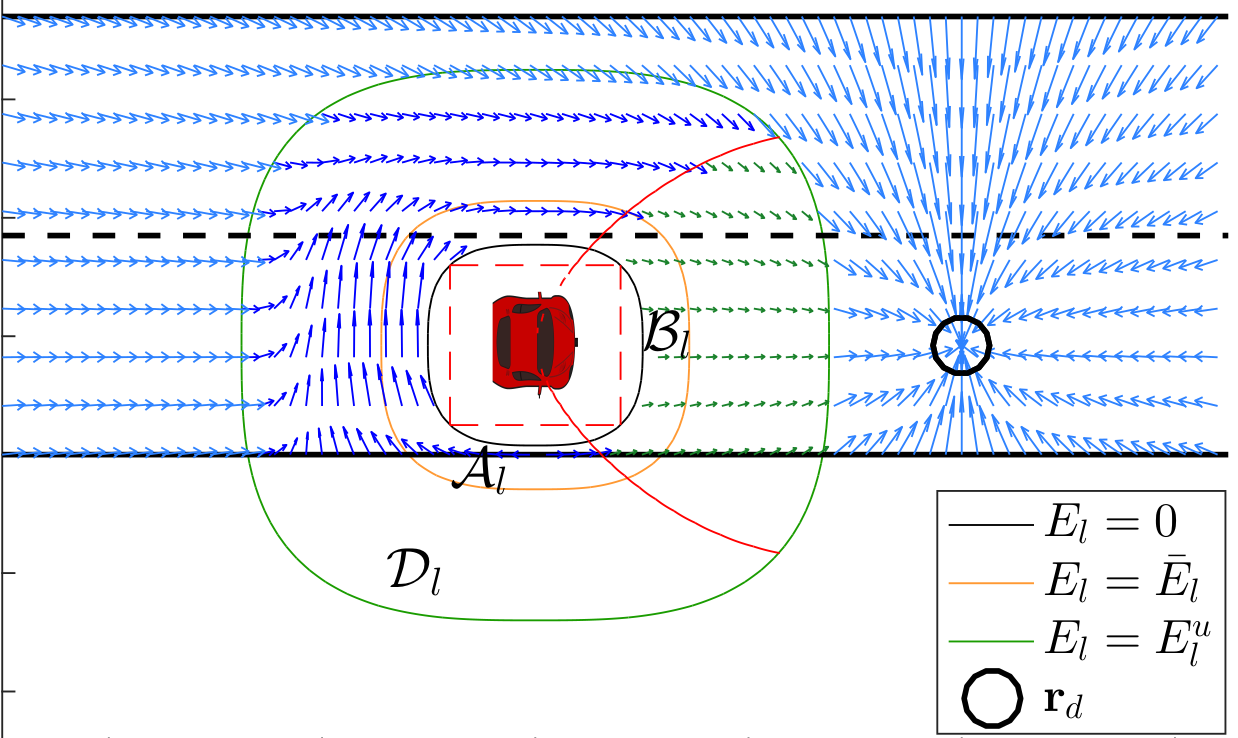
    In this project, we developed a vector-field based, real-time implementable motion planning algorithm for safe autonomous overtaking while taking into account the online inferred intent of other vehicles on road.
    Reference:
    1. Vishnu S. Chipade, Q. Shen, L. Huang, N. Ozay, Sze Zheng Yong, Dimitra Panagou, " Safe Autonomous Overtaking with Intention Estimation," 2019 European Control Conference, Napoli, Italy, June 2019.
    MATLAB Simulations:
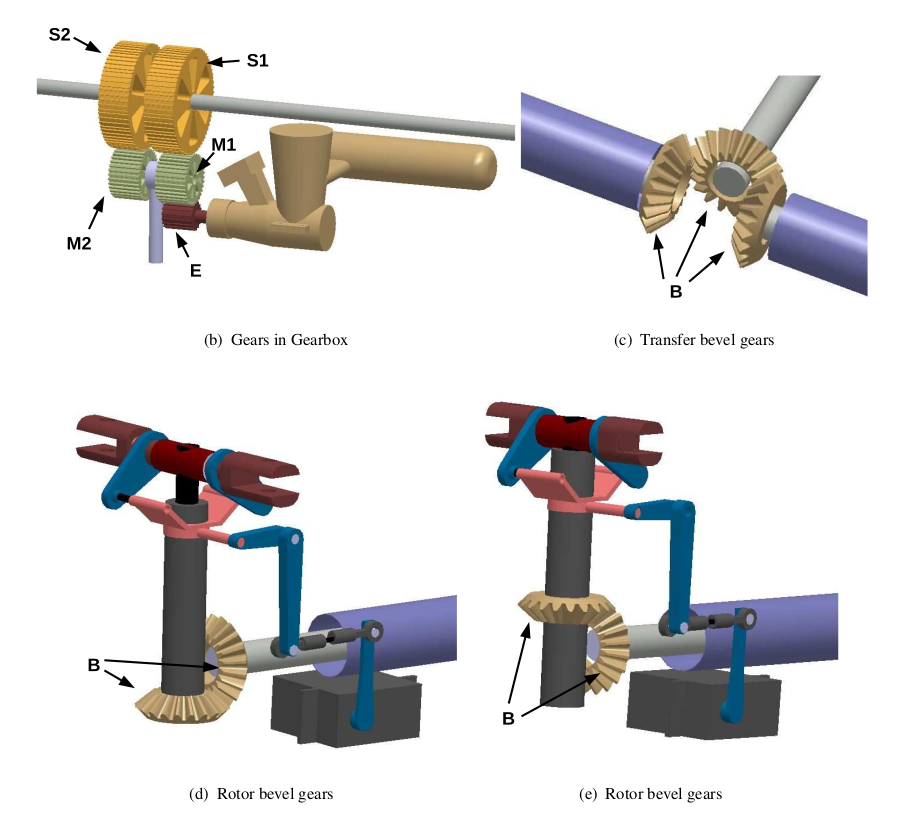
  • Quad Biplane: A hybrid umannaed aerial vehicle UAV

    fixed bipane vtol uav
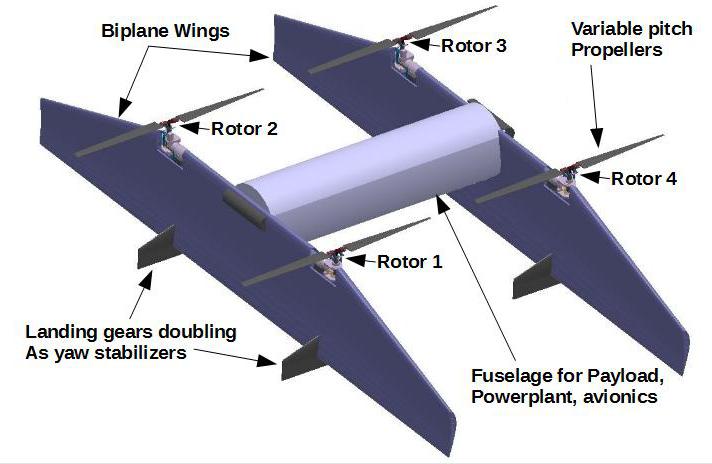
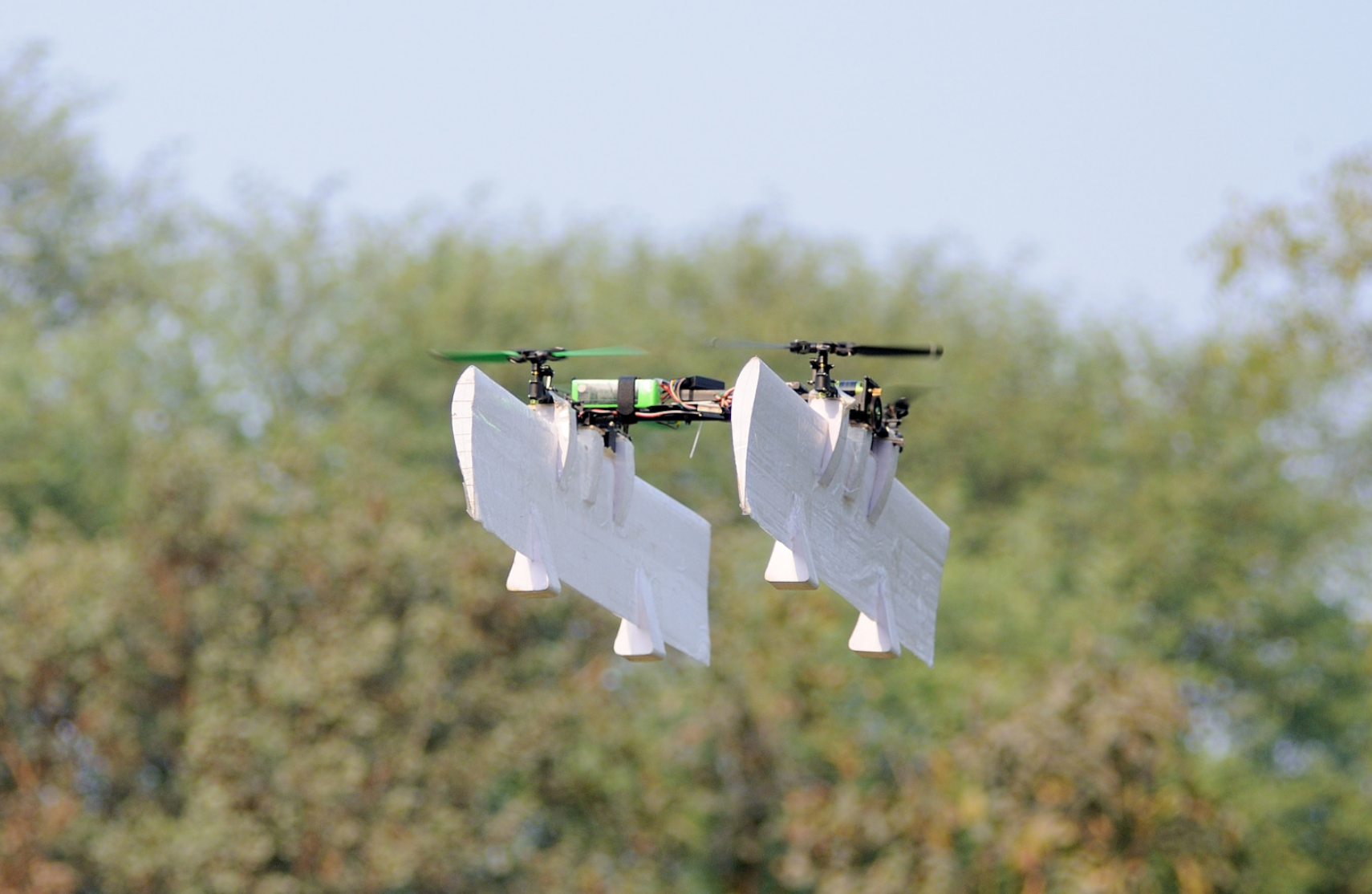
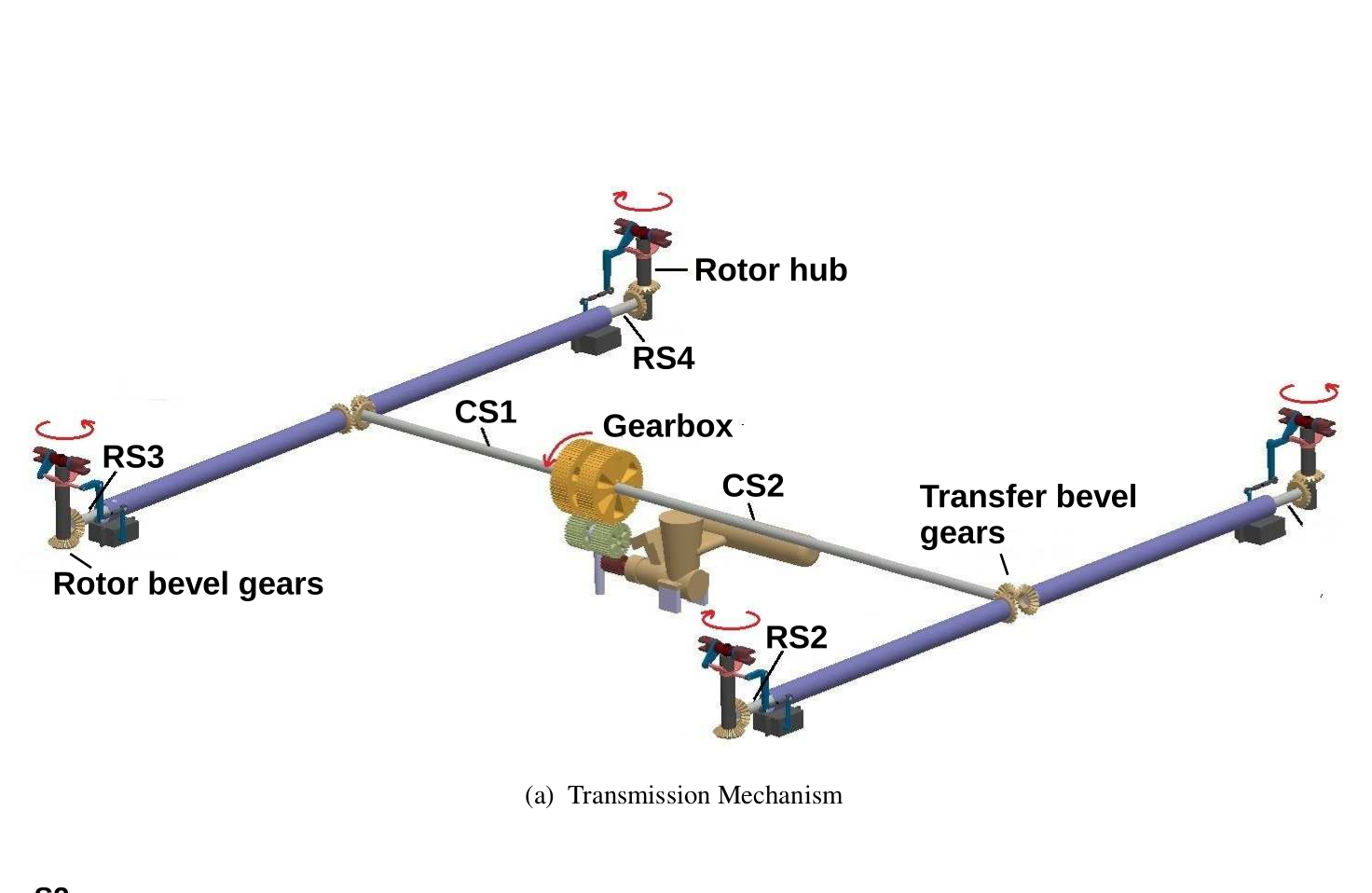
    In this project, we designed and developed a novel hybrid UAV design, composing of the traditional quadrotor body mounted with fixed biplane wings. This hybrid UAV combines helicopter characteristics of a quadrotor such as vertical take-off and landing capabilities and fixed-wing characteristics of a biplane such as high speeds and long range. We systematically and optimally designed: 1) efficiet proprotors using modified blade element theory (BEMT) for performance predictions, 2) compact and efficient wings using the monoplane design approach while optimizing the benefits of biplane configuration, and 3) other aspects of the design such as efficient and long endurance power plant, effective transmission mechanism, and reliable avionics kits using appropriated techniques. We also fabricated tested a prototype of the design to demonstrate its capabilities.
    References:
    1. Vishnu S. Chipade, Abhishek, M. Kothari, R. Chaudhari, " Systematic design methodology for development and flight testing of a variable pitch quadrotor biplane VTOL UAV for payload delivery," Mechatronics, 2018.
    2. Abhishek, M. Kothari, N. Gupta, Vishnu S. Chipade, N. Gupta, R. Chaudhari, and R. V. Singh, " An umannaed aerial vehicle having a fixed biplane wing ," India Patent No.: 507670, Dated: 03 May 2016.
    Experiments:

Publication